Marriage Biodata Format with Horoscope
A biodata with horoscope has two parts: the usual personal, family and contact details, and a horoscope block — the Rashi, the Nakshatra and the Lagna in words, followed by the Rasi and Navamsa charts. In South India the charts are expected on the sheet; in much of North India they are optional and the kundali is often sent separately.
Here the horoscope block is calculated, not typed. Enter the date, time and place of birth once and both charts are drawn on the biodata itself, in your language.
Free to build and preview · no login.
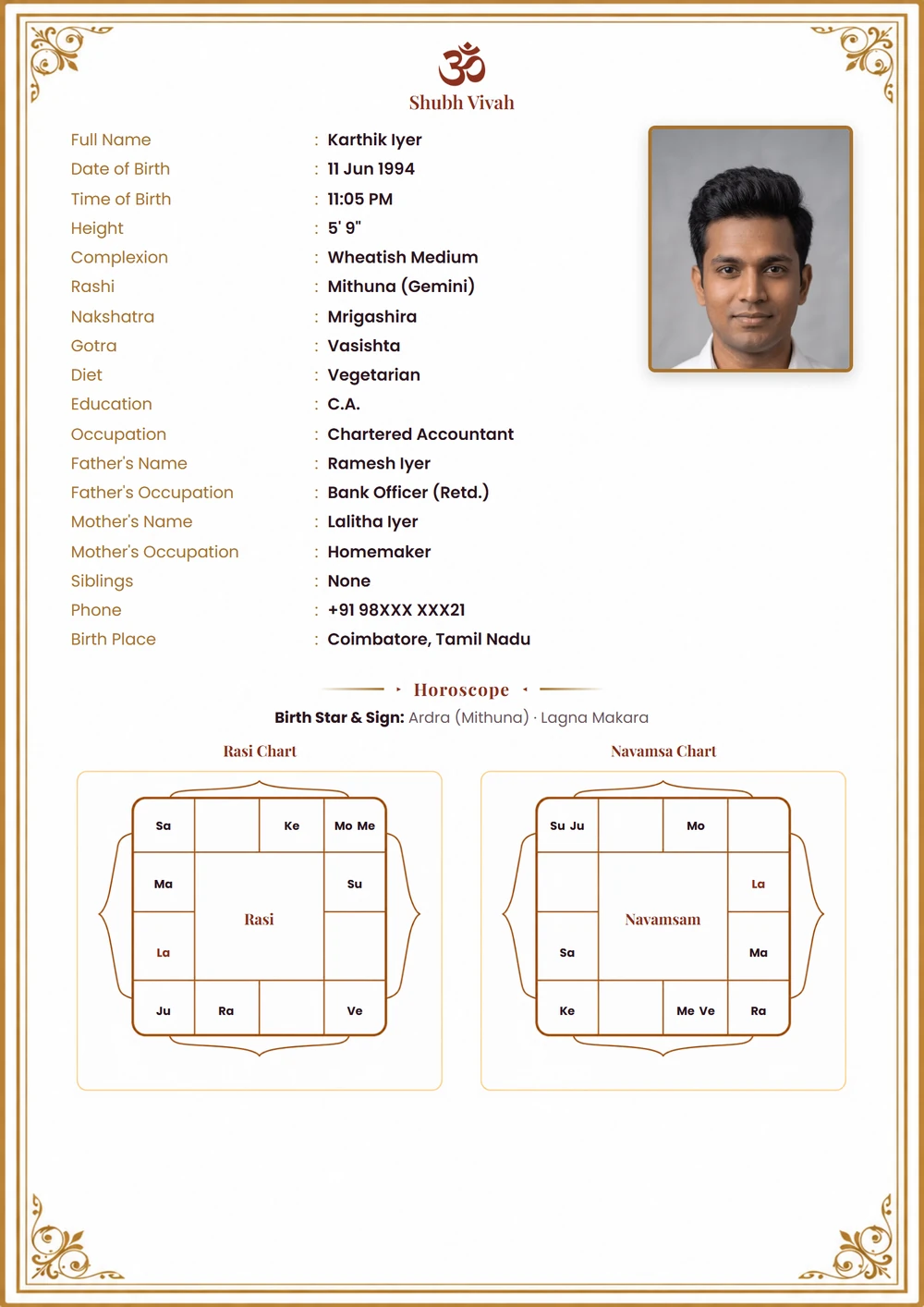
How to read the horoscope part
Rasi chart
The birth chart: which sign each planet was in at the moment of birth. The twelve boxes around the edge are the twelve signs, always in the same place; only the planets move.
Navamsam chart
The same planets, placed by the ninth part of the sign they were in (each sign split into nine slices of 3°20′). Families and astrologers read it closely for marriage.
Lagnam
The sign rising in the east at the moment of birth, marked in its box. It changes about every two hours, which is why the birth time matters.
Nakshatram and Rasi
The Moon's star (one of 27) and the Moon's sign (one of 12). They are printed in words above the charts, and they are the first thing compared for porutham.
What the short names in the boxes mean
- LaLagna (Asc)
- SuSun
- MoMoon
- MaMars
- MeMercury
- JuJupiter
- VeVenus
- SaSaturn
- RaRahu
- KeKetu
What goes in the horoscope part
- Birth Star (Nakshatra) — the Moon's star at birth, one of 27
- Rashi — the Moon's sign, one of 12
- Lagna — the sign rising in the east at the moment of birth
- Rasi chart — where every planet stood at birth
- Navamsa chart — the ninth-division chart many families read for marriage
What the horoscope looks like on the sheet
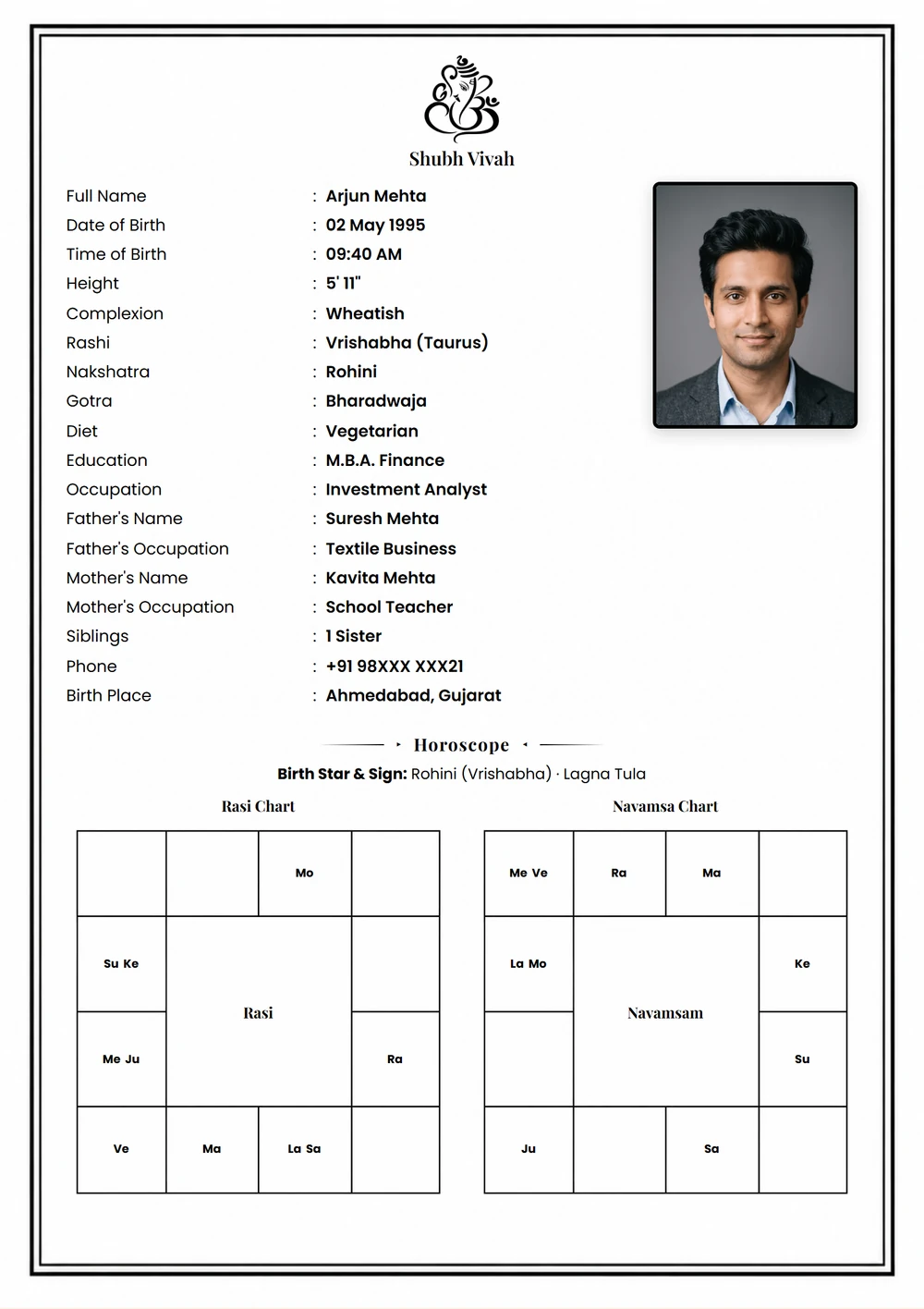
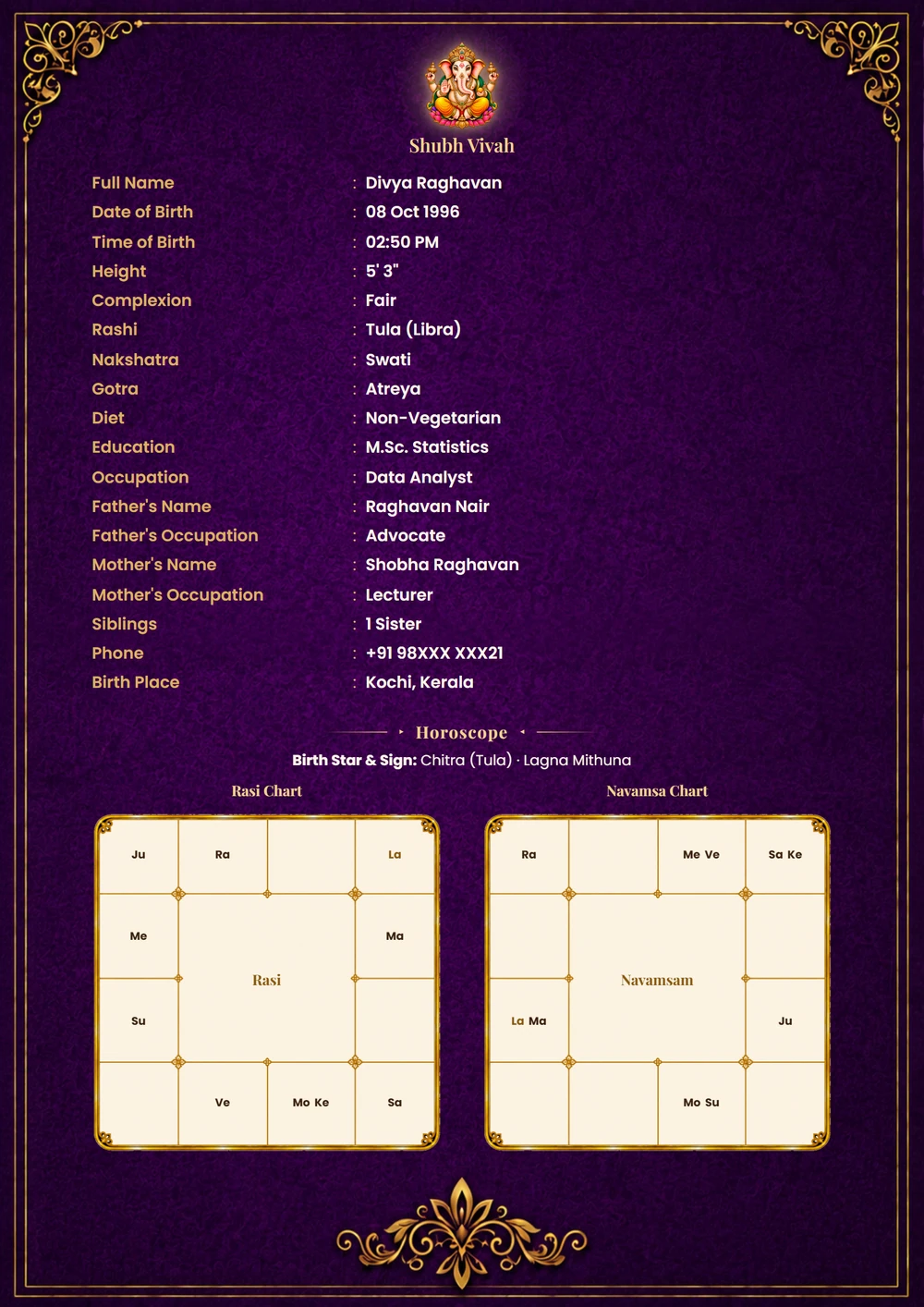
Two designs with the charts printed under the details — the same sample person on both.
Which chart style is used
The South-Indian square chart: the twelve signs sit in fixed boxes around the edge, and the planets move between them. It is the style Tamil, Telugu, Kannada and Malayalam families use. The North-Indian diamond chart is not offered.
The chart titles and the planet names inside the boxes print in Hindi, Tamil, Telugu, Kannada and Malayalam; the other languages use the English ones (Rasi Chart; Su, Mo, Ma…).
Three steps
Fill the biodata
Personal, family and contact details, in any of 12 languages. Type in English and pick your script's suggestion.
Switch the horoscope on
It is on by default for Tamil, Telugu, Malayalam and Kannada, and one toggle away for the rest. Pick the birth town and the charts are drawn; any planet can be moved by hand.
Choose a design and download
Preview free in every design. Designs that print the charts start at ₹29; the free Free Classic design lists the star and rashi as text.
Common questions
Is the horoscope compulsory?+
No. It is a switch. It starts on for Tamil, Telugu, Malayalam and Kannada, off for the other languages, and always off for Muslim, Christian, Sikh and Buddhist biodatas. Turning it off hides it without deleting what you entered.
How are the charts calculated?+
From the date, time and place of birth, using sidereal positions with the Lahiri ayanamsa; Rahu and Ketu use the mean node. If your family's horoscope was written by an astrologer, you can place every planet by hand instead, and that is what prints.
Can I copy the horoscope from an existing kundali?+
Yes. Click a box in the Rasi or Navamsa chart and tick the planets that belong in it. A hand-edited chart is never overwritten by a recalculation unless you ask for it.
Is it free?+
Building and previewing are free. Downloading a design that prints the charts costs from ₹29, once, with no login or subscription. The free Free Classic design has no charts.
Make a biodata with horoscope
Five minutes, no login. Preview every design free; pay only for a design you download.
Start now